
Paco Marcial
By the 1960’s in American & European Motorsport circuits a ubiquitous presence was unavoidable: The Marker. It was a way to point an important feature, a curve, a chicane, a mechanics pit, so drivers were aware of places & consecutively calculate distances. Companies use them to promote their products way before publicity took over the car itself.
This was the time also when, a famous character took the form of “the average American “: Donald Duck. In the comics he was the equivalent of that era to Homer Simpson. Those comics were read by adults. Some of them were those racers that, saw an opportunity to bring into real life the character of the duck as a high tempered but also an Speed Freak, creating from T-shirts to Banners.
This work is a homage to both worlds, creating a kind of new marker that’s simply wanting to bring a presence that, helps to an Art Exhibition to follow a route as a real marker at the beginning or the end of the map in a real Art Circuit!
Marker for A Duck
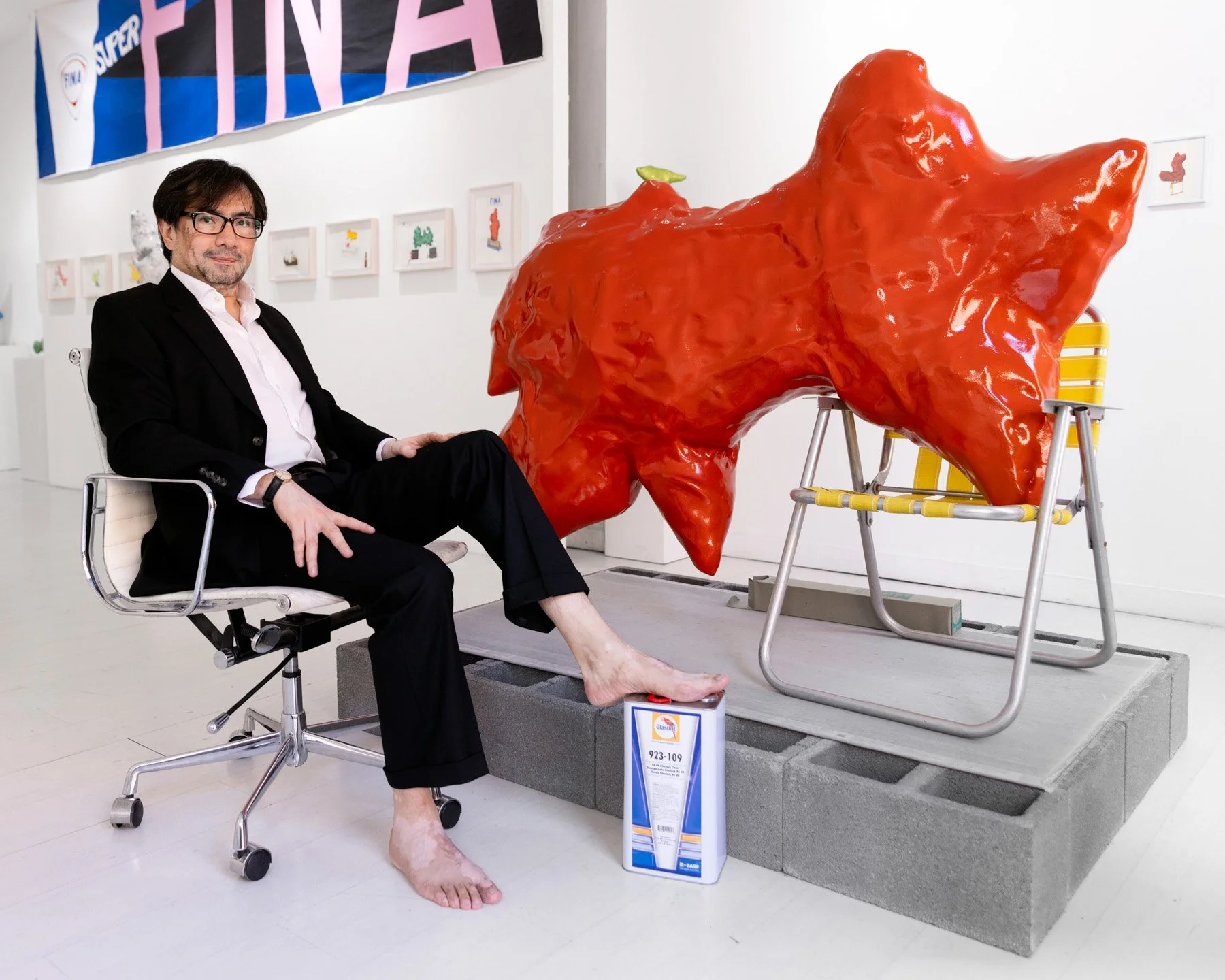
Paco Marcial was born in Mexico City and received his BFA at Escuela Nacional de Artes Plásticas ENAP UNAM, in Mexico City. With postgraduate studies at the Jan Van Eyck Akademie in Maastricht Netherlands. Also besides art schools, under the mentorship of some artists: Melquiades Herrera, Jason Rhoades, Raymond Pettibon & Franz West. Extracurricular- Between 2000 & 2006 he was Jason Rhoades assistant. From 2006 to 2008 coordinated the Estate of Jason Rhoades for the galleries David Zwirner and Hauser & Wirth. In 2012 he was an artist in residence on the inaugural residencies at Prattsville Art Canter in Prattsville, New York.

Fallow Frames Biennial 2026
September 19 — 20 2026
Ridgewood, Queens NY
1pm — 6pm
20 Empty Tree Beds - 24 Participating Artists
Ridgewood's sidewalks contain more than 800 empty street tree beds, roughly one for every 90 residents. For one weekend, twenty of these overlooked spaces will be transformed into temporary, site-specific artworks by 23 participating artists.
Visitors are invited to explore the neighborhood on foot, discovering how contemporary art can temporarily transform familiar streets while reflecting on public space, urban ecology, and the hidden potential of the city's overlooked landscape.