
Paul Krause
Ladder of Khnum is a sculptural installation which takes on a performative element while the piece is created in situ, for interested onlookers to observe, during the course of the Fallow Frames Biennial. As the title implies, Krause has constructed a skeletal substructure based off of a found, wooden 4' step ladder. The ladder is attached to a wooden base and its sides are clad with wooden shelves aligned with the steps of the ladder, creating a pyramidal type form. Next Krause takes to the potter's wheel and begins throwing vessels. While the clay is still soft, the vessels are loosely attached to the wooden ladder structure. The erect vessel forms slump and contort during this process creating a writhing, undulating surface that climbs to a point as it conforms to the ladder's architecture. This process continues until the entire structure is fully covered.
Ladder of Khnum
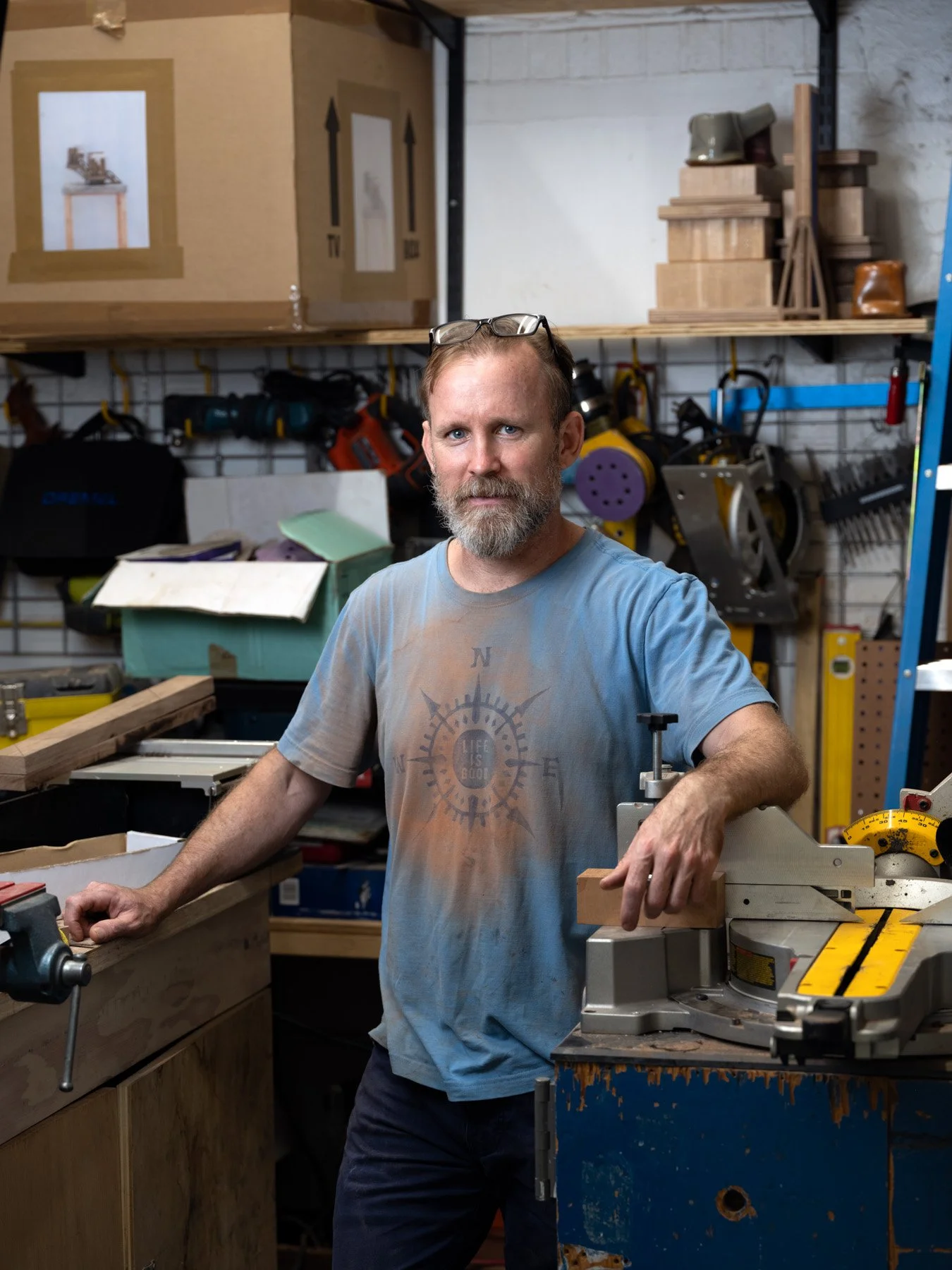
Paul Krause is a mixed media artist whose work explores ideas about abstraction, metaphor and process, through craft, material exploration and symbolism. Krause began his formal art education at the University of Colorado, where he earned a Bachelor of Fine Art with an emphasis in ceramics. He furthered his education with a two-year apprenticeship to artist Chris Gustin. He has been awarded residencies at Moravian Pottery and Tile Works in Doylestown, PA , Peters Valley School of Craft in Layton, NJ and Anderson Ranch Art Center in Snowmass, CO. Krause currently lives in Queens, NY where he has maintained an active studio practice since 2004. He has exhibited in galleries and museums in the United States and abroad.

Fallow Frames Biennial 2026
September 19 — 20 2026
Ridgewood, Queens NY
1pm — 6pm
20 Empty Tree Beds - 24 Participating Artists
Ridgewood's sidewalks contain more than 800 empty street tree beds, roughly one for every 90 residents. For one weekend, twenty of these overlooked spaces will be transformed into temporary, site-specific artworks by 23 participating artists.
Visitors are invited to explore the neighborhood on foot, discovering how contemporary art can temporarily transform familiar streets while reflecting on public space, urban ecology, and the hidden potential of the city's overlooked landscape.