
ArtSwitch with Carlos Irijalba
Field Conditions
For Fallow Frames 2026, Art Switch Foundation has commissioned Carlos Irijalba to develop an art installation framed by a tree bed in Ridgewood, Queens.
The tree bed is a peculiar urban territory: part infrastructure, part habitat, part leftover space. It is designed, measured, and contained, yet never fully under control. A tree is given a fixed opening in the sidewalk: roots are expected to remain below the surface and spontaneous growth is tolerated only up to a point.
As New York’s climate shifts, so do the conditions of what can live here. Irijalba pproaches the tree bed as an ecosystem, embracing the idea of endosimbiosis as a matryoshka doll. The tree bed, defined by the geological, urban and natural features that contain and challenge it, becomes a miniature reflection of the city it’s inscribed in.
Through magnification, perspectives shift: an insect becomes monumental, a fragment of litter resembles an unfamiliar geology. Trash begins to echo the forms, textures, and colors of the natural world, blurring the line between adaptation and intrusion. Mimicry becomes a through line not only in the natural world but also in the artificial.
Field Conditions asks us to reconsider proportion and ecological adaptation in the tree bed and beyond. At what point does debris become habitat, or the foreign become local? What kind of scale is sustainable and for whom?
Building on Art Switch’s ongoing programs Sensing Change, Nature Thinking, and Sonic Acts of Nature, the commission asks what art can help us notice when we slow down and look more closely.
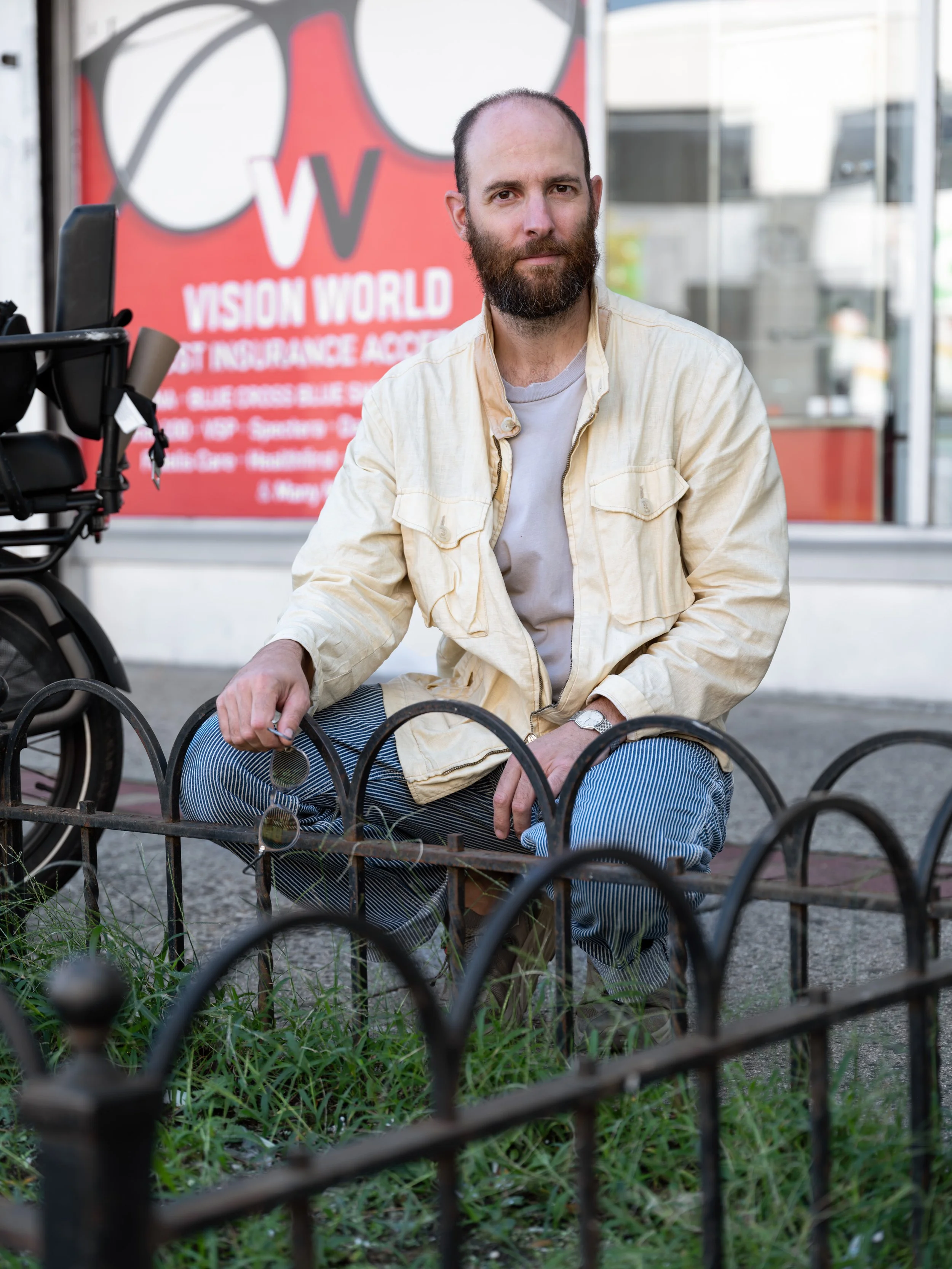
Carlos Irijalba’s work is driven by the principle of pertinence, the necessary or superfluous character of an object to exist in the world. His approach reflects a responsibility toward the objects we secrete, recognizing that silence or void may sometimes be the best contribution. Irijalba’s objects, images and installations activate the places they inhabit, reacting to the relative experience of time, space and the fictional construction of the territory. Here, geological tempo and natural and human-made cycles become crucial to the criticality of the present moment.
Carlos Irijalba [Pamplona, 1979] was a resident at the Rijksakademie in Amsterdam (2013/2014) and graduated from the Basque Country University and UDK Berlin in 2004. He has received numerous awards including the Guggenheim Bilbao Photography Grant (2003), the Marcelino Botín Art Grant (2007/08), the Shifting Foundation Grant and first Prize, and the Revelation PhotoEspaña Prize. Irijalba has exhibited internationally, including at the CCCB Barcelona, MUMA Melbourne, and LMCC New York.
artist website
Art Switch Foundation is a NYC–Amsterdam-based nonprofit convening artists, scientists, educators, and cultural practitioners around ecology, public engagement, and artistic experimentation. Through artist talks, performances, research-based programming, and interdisciplinary dialogue, they create spaces where art becomes a catalyst for new ways of sensing, thinking, and relating to the living world.
Engaging with cultural and academic institutions, Art Switch supports partnerships that bridge disciplines, challenge established frameworks, and imagine regenerative futures for the arts and the environments they inhabit.
As part of this mission, they collaborate with artists whose work fosters dialogue between artistic practice, scientific inquiry, and ecological awareness. For Fallow Frames 2026, Art Switch is pleased to partner with artist Carlos Irijalba on a site-responsive work.
website

Fallow Frames Biennial 2026
September 19 — 20 2026
Ridgewood, Queens NY
1pm — 6pm
20 Empty Tree Beds - 24 Participating Artists
Ridgewood's sidewalks contain more than 800 empty street tree beds, roughly one for every 90 residents. For one weekend, twenty of these overlooked spaces will be transformed into temporary, site-specific artworks by 23 participating artists.
Visitors are invited to explore the neighborhood on foot, discovering how contemporary art can temporarily transform familiar streets while reflecting on public space, urban ecology, and the hidden potential of the city's overlooked landscape.